Seven years to create a novel and we are to publishing/promoting phase. What an unbelievable journey and sincere gratitude to those who have supported this project along the way.
Novel ideas and explanations
Seven years to create a novel and we are to publishing/promoting phase. What an unbelievable journey and sincere gratitude to those who have supported this project along the way.
Our emotions flow through us, like water.
Of course, water freezes and thaws.
Water can destroy, yes, but above all, water means life.
Nebraska’s water supply started its journey around 65 million years
ago, when a thick sheet of ice slid southeast at a slow and steady pace. As
it crept and melted, this ancient glacier carved the hills and valleys. Then,
Mother Earth’s climate shifted, causing the ice to melt.
This water pressure shifted tectonic plates, forming the mountain
ranges of North America. The Rockies and Appalachians trapped the
glacial melt and flooded the Great Plains region, creating the Cretaceous
Sea. Sediment erosion from the Rocky Mountains flowed from its rivers
into Nebraska, sifting the water underneath to create the Ogallala Aquifer.
This huge, natural underground cavern sustains us all here on the plains.
It is quickly being depleted, and is not easily replenished.
My father had strategically formed ice around his heart, and the loss
of my mother shifted the climate. The ice melted; it carved valleys, built
mountains, flooded the solid ground he thought he could navigate.
Dad shoved his feelings underground, but by the time he realized his
most precious resource was drying up, it was almost too late to replenish it.

“The Ogallala aquifer is slowly getting depleted, with the water table dropping by as much as two feet per year in some counties. And once they drain, it could take hundreds or thousands of years for those ancient aquifers, which were first formed millions of years ago, to fully recharge with rainfall.”
by Brad Plumer, the Washington Post
“Because the author provides a deep dive into each character during their journey together, the reader is able to sympathize with severe generational abuse associated with Marley, Seth, Layne, and Otis. Stacey Cahill weaves the importance of talk therapy throughout the story and provides the reader with a level of comfort and understanding one would typically find impossible when discussing such difficult subjects. There is a great spiritual aspect to this story; in combination with sound counseling practices, these are the only things that could possibly explain drastic changes in the characters over time. Traffic Stop: Human Division” is a deep dive into the minds of both victims and perpetrators and masterfully highlights the importance of accepting help to work through all of life’s traumatic events.”
Bailey J. Koch, Ed.D
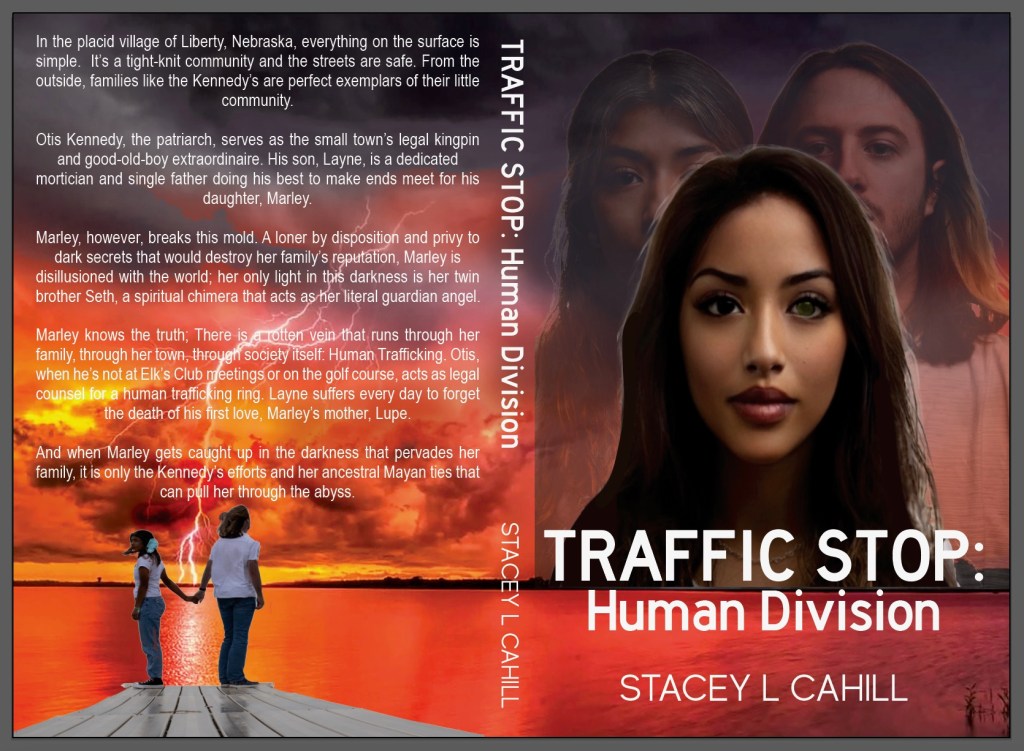
In the past few weeks, I have been working on Traffic Stop: Human Division’s cover with a professional photographer, willing models, and a creative graphic designer. We are getting close to finalizing the details. Once this takes place, the e-book version will be out into the world in 45 days and the paperback will be available in about three months!
There’s been much to consider when creating this cover. It’s the first thing people notice when picking up a book. The questions I have asked myself on the regular are as follows: Does it catch the eye and attention of the potential reader? What is the symbolism I want to portray in this first impression? Is it offensive or discriminatory in any way?
Whoever said, “you can’t judge a book by it’s cover” was correct on so many levels, and also equally misinformed. We should not judge, period. There is so much depth and breadth of information underneath what is shown. However, the human race glances, assesses, and decides in a heartbeat whether this cover in front of them is worth the investment of their time and attention. Don’t we do the same when we meet new people?
While collaborating on the novel’s cover, my character, Layne, has been on my mind. He is a suicidal mortician and hides behind a mask of platitudes. The public persona he portrays is that of a competent, empathetic individual who will respectfully care for the dead so the community doesn’t have to. His inner demons devour him with guilt, shame, depression, and angst for the failure he feels he has become. How conditioned people are to cover their shame with some false attributes assumed that others desire…
Utopia, to me, would be if people withheld judgement of others and instead opened up a dialogue to understand and know (really know) someone else. I wonder how much richer and enhanced our relationships would become. We could deep dive into the content and history presented by the person in front of us, not our assumption or misperception of them.
In my utopia, genuine-ness would be normalized and valued. Vulnerability would be the go-to option rather than the one most people avoid at all costs. There seems to be fewer people willing to be real and raw with each other. Most people I know hide behind one cover or another in the name of self-protection. What a calamity to waste an exorbitant amount of precious time and energy on mask-wearing and cover-ups.
The cover chosen to embody the contents of Traffic Stop: Human Division will be genuine, vulnerable, and to the best of my ability, a visual snapshot of the essence within the written words. Like me, there are imperfections throughout; the face I present to the world, the body of information that unfolds. And like me, I am open to genuine, vulnerable feedback. Thanks for covering my back.
I wrote Traffic Stop: Human Division to bring mass awareness of how prevalent human trafficking is in our world. Sex has become a commodity to make powerful people rich and children broken. I long for trafficking to stop.
When this topic comes up, most people I know turn their attention elsewhere fast. I get it. Discussing sex trafficking is uncomfortable and it’s easier to pretend it doesn’t exist. It is even harder to live through. The common misconception is it could not happen to me or someone I loved or that trafficking doesn’t occur in places like small town USA.
It does.
It’s happening everywhere.
And I guarantee you have met a trafficking victim, a perpetrator/consumer, or both.
People are divided in thirds when it comes to trafficking. The first third are those with power and control. These people, like my character Otis Kennedy, are not motivated to stop human trafficking because there is pleasure, power, and an overwhelming amount of money involved. If it weren’t for this third of the population, there would not be the other two thirds. Innocent victims and oblivious bystanders.
Innocent victims are those vulnerable people, namely our children, who are resourced, used, and manipulated for other’s gain. Although these people may be motivated to stop trafficking, they don’t hold the power to do so. They have lost their voices, like my main character Marley Kennedy. She won’t get to share her story until the end of the novel for this reason.
The last third are those people I wrote this novel for. These are the people who are in denial or unable to acknowledge the effects sex trafficking has on us all, like Marley’s father, Layne, or her grandmother, Momma Jane.
I have spent the majority of my counseling career loving those who suffer. Although not the majority of my practice, I have worked with trafficking survivors in a Central Nebraska town population 10,000. Just south of my hometown in an even smaller village, the authorities caught and sentenced a man and his colleagues for trafficking a teen.
Trafficking starts in our homes through the internet and other means. Perps are stealth and cunning to identify the vulnerable, gaining our children’s trust, and “snatching them away.” I wanted to address this misconception by writing the novel. Most trafficked individuals actively live with their family while being manipulated, coerced, and/or bribed to participate in trafficking activities.
Trafficking effects boys, as well as girls. It effects children as young as infants and beyond. Some parents sell their children as a means to survive. Some parents are oblivious to where there children are and the dangers that lurk. Some homes these children have grew up in was were where they were sexually perpetrated on first, leading them to believe sexual abuse is “normal.”
I hope you will join me in spreading awareness, protecting and loving the vulnerable, and holding perpetrators accountable for the suffering they cause to humanity. I believe the only way to stop human sex trafficking is for the third bystanders who has been stagnant in “the by and by” to actively stand together against perpetrators.
Elvis Presley “By and By”
Each week I will take one of the mental health issues or overriding emotions covered in the novel Traffic Stop: Human Division and take a deep dive with you on what each of these entail. Likely, I’ll nerd out on this because it’s my wheelhouse, so thank you in advance for humoring me! I figured those interested in reading the novel needed a firm foundation from which to launch into the character’s internal and external conflicts. Even if you have a mental health background, it is important to me that we begin this novel on the same page.
I plan to begin with the all encompassing emotion of shame people experience, supported by the research of Brene Brown. I will pepper in addiction issues, depression, obsessive-compulsive disorder, posttraumatic stress disorder, narcissism, borderline personality disorder, co-dependency, cycle of abuse/domestic violence, etc. Of course, human trafficking will make it’s mark in this blog, since this topic is the premise and lends to the novel’s title. I will also offer treatment options and a sprinkling of research to back what I share.
I’m excited to provide updates on the publishing journey and prepare you, dear readers, to meet the characters who bring this story to life.
This fictional adult Christian novel unfolds the deplorable reality of violence and coercion against children in our own backyard and provides hope for healing relationships whose foundations are fractured beyond repair.
Seth Kennedy has always been the angel on his twin sister’s shoulder…literally, until Marley Kennedy decides she’s had it with Seth’s Christian influence. After all, it hasn’t protected her, so why continue to trust her innermost voice? As Marley becomes enveloped by the world, their connection is severed and both become invisible.
Layne Kennedy, a suicidal mortician and father of Marley (and unbeknownst to him, Seth), Layne finds himself spinning alone in his grief after the accidental death of his first love, Lupe. All Layne wants in life is to survive and to be a better father to Marley than Otis ever was.
Otis Kennedy, a pillar in a small Midwestern community as a big shot attorney, dabbles on the side in the upper echelons of a human trafficking ring. When Otis’ only granddaughter goes missing, pride and sin loosen their grip on Otis. Against the odds, Otis and Layne forge an implausible duo to search for the lost Marley. All the Kennedy men discover they, too, have lost their way only to find what has been hidden in plain sight all along.
My intention is to increase readers’ awareness of human trafficking’s prominence, that it’s happening in clear view, and that the trafficked person is not always abducted as Hollywood depicts. I believe this book is necessary to enlighten people’s ignorance to the issues of human trafficking. My goals by writing this work are twofold; to break through denial/avoidance and to provide hope that healing is possible after trauma and exploitation.
There are so many decisions to make when it comes to writing a novel. If I would have known what I was getting myself into, I may not have invested 6 years into creating and editing a story, the money for an editor to comb through, or the time to research various publishing companies (plus creating a query letter for publishing agents to even look at the thing). I loved the creative process. I even enjoyed, much to my dismay, finding the exact wording that would convey the perfect message to the readers. But this part? This is for the birds.
Today’s hard lesson on my day-job day off was copyright laws. Snore, I know. I had to take two naps just to get through the material and decipher the legalese. I decided to do a poor man’s copyright which boils down to the following antiquated method: making a hard copy of the novel, taking it to the postal service, and sending it to myself. In case there’s ever a question, I have an unopened and post marked original document to prove I own the material therein. This will have to suffice because I can’t afford any more naps.
Query letters have flown from my computer to various publishing agent’s inboxes. I am impatiently awaiting a response of interest. So far, I’m zero for zero with no responses and no interest. Ironically, that’s the good news. The bad news is that it can take up to three months for agents to even read the information submitted. My personal goal was to be published by March 10, 2023. I have one day to clench the win! So…
Self-publishing is a viable option, however, there are mixed reviews on whether that is the best route for a newbie novelist. I’m going to make the most of this time waiting for a publisher by creating the next writing adventure. I plan to help edit my bestie’s short story and help her navigate the Amazon self-publishing world, so if no publishing agents pursue Traffic Stop: Human Division, I will pull the trigger and send this novel through the Amazon platform with ease. It’s coming, I just can’t tell you when.

 Traffic Stop: Human Division